Is Reasoning From Scratch Production Ready? Deep Dive & Setup Guide
Technical analysis of Reasoning From Scratch. Architecture review, deployment guide, and production-readiness verdict. 2.4k stars.
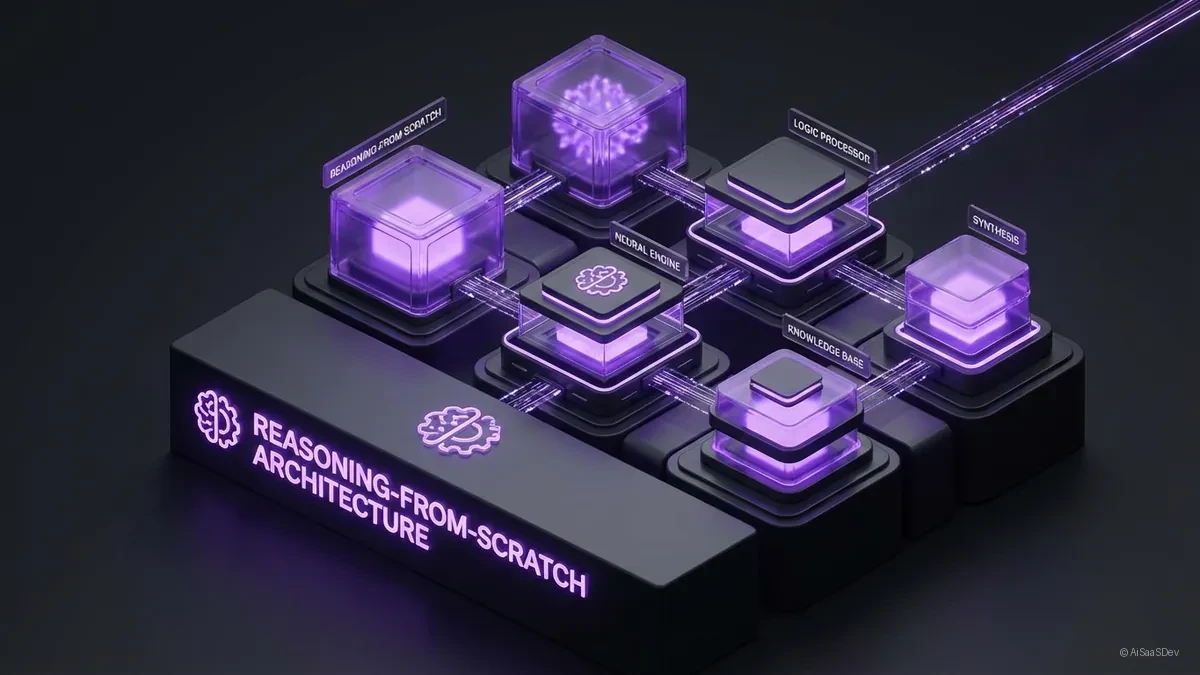
Reasoning From Scratch is trending with 2.4k stars. Here is the architectural breakdown.
🛠️ What is it?
Reasoning From Scratch is an educational codebase designed to demystify the “black box” of modern reasoning models like OpenAI’s o1 and DeepSeek-R1. Instead of relying on high-level APIs, this repository implements the entire reasoning pipeline-from the base Large Language Model (LLM) architecture to the complex Reinforcement Learning (RL) loops required for “thinking” capabilities-using pure PyTorch.
It serves as the official companion to Sebastian Raschka’s book, focusing on transforming a standard pre-trained LLM (specifically Qwen3-0.6B) into a reasoning model capable of solving complex math and logic problems through Chain of Thought (CoT) and self-verification.
🏗️ Architecture
The project is structured as a progressive build, moving from basic inference to advanced RL techniques.
1. The Base Model (Qwen3 Implementation)
Unlike many tutorials that import transformers.AutoModel, this repo implements the Qwen3 architecture from scratch in reasoning_from_scratch/qwen3.py.
- Core Components: Custom
TransformerBlock,GroupedQueryAttention, andRMSNormmodules. - Optimization: Includes manual implementations of KV Caching for fast inference and supports
torch.compilefor graph-level optimizations. - Weights: It loads official Qwen3-0.6B weights into this custom architecture, bridging the gap between theory and production-grade weights.
2. The Reasoning Pipeline (GRPO & RLVR)
This is the “secret sauce” behind models like DeepSeek-R1. The repo implements Reinforcement Learning with Verifiable Rewards (RLVR).
- Algorithm: It uses GRPO (Group Relative Policy Optimization), a more efficient alternative to PPO that eliminates the need for a separate value function critic model.
- Scoring: It uses programmatic verifiers (e.g., Python scripts or SymPy) to grade math problems (MATH-500 dataset).
- Loop: The model generates multiple “thought” traces; correct answers are rewarded, and the policy is updated to favor the reasoning paths that led to those answers.
3. Inference Scaling
The architecture explores “test-time compute” scaling methods:
- Best-of-N: Generating multiple candidate solutions and selecting the best one based on a verifier or reward model.
- Self-Consistency: Majority voting on the final answer across multiple reasoning paths.
🚀 Quick Start
This guide sets up the environment and runs a basic inference test using the custom Qwen3 implementation.
Prerequisites: Python 3.10+ and a machine with a GPU (CUDA/MPS) is recommended, though it runs on CPU.
1. Clone and Install
The repository recommends using uv for fast dependency management, but standard pip works as well.
# Clone the repository
git clone https://github.com/rasbt/reasoning-from-scratch
cd reasoning-from-scratch

# Install dependencies (using pip)
pip install -r requirements.txt

# Install the local package in editable mode
pip install -e .
2. Run Inference (Hello World)
This script downloads the Qwen3-0.6B weights and generates text using the custom implementation with KV-caching enabled.
import torch
from reasoning_from_scratch.qwen3 import download_qwen3_small, Qwen3Tokenizer, Qwen3Model, QWEN_CONFIG_06_B
from reasoning_from_scratch.ch02 import generate_text_basic_cache, get_device

# 1. Setup Device
device = get_device() # Auto-detects CUDA, MPS (Mac), or CPU
print(f"Running on: {device}")

# 2. Download & Load Model (approx 1.5GB)
# This downloads weights to a local 'qwen3' folder
download_qwen3_small(kind="base", tokenizer_only=False, out_dir="qwen3")

tokenizer = Qwen3Tokenizer(tokenizer_file_path="qwen3/tokenizer-base.json")
model = Qwen3Model(QWEN_CONFIG_06_B)
model.load_state_dict(torch.load("qwen3/qwen3-0.6B-base.pth", map_location=device, weights_only=True))
model.to(device)

# 3. Generate Text
prompt = "Explain how Large Language Models reason in one sentence."
input_ids = torch.tensor(tokenizer.encode(prompt), device=device).unsqueeze(0)

print("Generating...")
output_ids = generate_text_basic_cache(
    model=model,
    token_ids=input_ids,
    max_new_tokens=50,
    eos_token_id=tokenizer.eos_token_id
)

print("\nResponse:")
print(tokenizer.decode(output_ids.squeeze(0).tolist()))
⚖️ The Verdict
Reasoning From Scratch is an Educational Gold Mine, but it is not intended for production deployment.
Strengths
- Transparency: It peels back the layers of abstraction found in libraries like Hugging Face, showing exactly how attention, KV-caches, and RL loops work mathematically and programmatically.
- Cutting Edge: It covers GRPO and RLVR-techniques that are currently redefining the state-of-the-art in AI (used by DeepSeek-R1).
- Efficiency: The implementation focuses on the 0.6B parameter scale, making it runnable on consumer hardware (even laptops), which is rare for reasoning model tutorials.
Weaknesses
- Not a Library: This is code for learning, not a package to import into your SaaS backend. It lacks the robustness, error handling, and optimization of vLLM or TGI.
- Limited Scope: It focuses specifically on the Qwen3 architecture and math/reasoning tasks.
Production Readiness: 1/10 (By Design)
Do not use this to serve traffic. Use this to train your engineers. If you are building an AI product, studying this repository will give you the intuition needed to fine-tune and optimize enterprise-grade reasoning models effectively.
Recommended Reads

Is Deepnote Production Ready? Deep Dive & Setup Guide
Technical analysis of Deepnote's open-source ecosystem. Architecture review, deployment guide, and production-readiness verdict. 2.5k stars.
Is SparkyFitness Production Ready? Deep Dive & Setup Guide
Technical analysis of SparkyFitness. Architecture review, deployment guide, and production-readiness verdict. 2.0k stars.
Is Marktechpost AI Tutorials Production Ready? Deep Dive & Setup Guide
Technical analysis of Marktechpost AI Tutorials. Architecture review, deployment guide, and production-readiness verdict. 1.9k stars.