Is OpenHands Production Ready? Deep Dive & Setup Guide
Technical analysis of OpenHands. Architecture review, deployment guide, and production-readiness verdict. 65834 stars.
Is OpenHands Production Ready?
OpenHands (formerly OpenDevin) is currently the heavyweight champion of open-source AI software engineering agents, boasting 65,834 stars and a massive 77.6% on SWE-Bench.
🛠️ What is it?
OpenHands is an autonomous AI software engineer capable of executing the full development lifecycle: writing code, running shell commands, managing git workflows, and debugging errors based on execution feedback.
Unlike standard “Copilots” that operate as autocomplete layers within an IDE, OpenHands operates as an agentic loop. It doesn’t just suggest code; it executes it in a sandboxed environment, observes the stdout/stderr, and iterates until the task is resolved.
Key Technical Differentiators:
- Runtime Sandboxing: It utilizes Docker containers to create ephemeral, safe execution environments. This allows the agent to install dependencies and crash processes without affecting the host machine.
- Composable SDK: The recent shift to a “Software Agent SDK” architecture allows engineers to treat agents as modular Python objects, enabling the programmatic definition of agent behaviors rather than just relying on prompt engineering.
- State Management: It maintains a persistent state of the file system and terminal history, allowing for context-aware decision-making over long-running tasks.
🏗️ Architecture Deep Dive
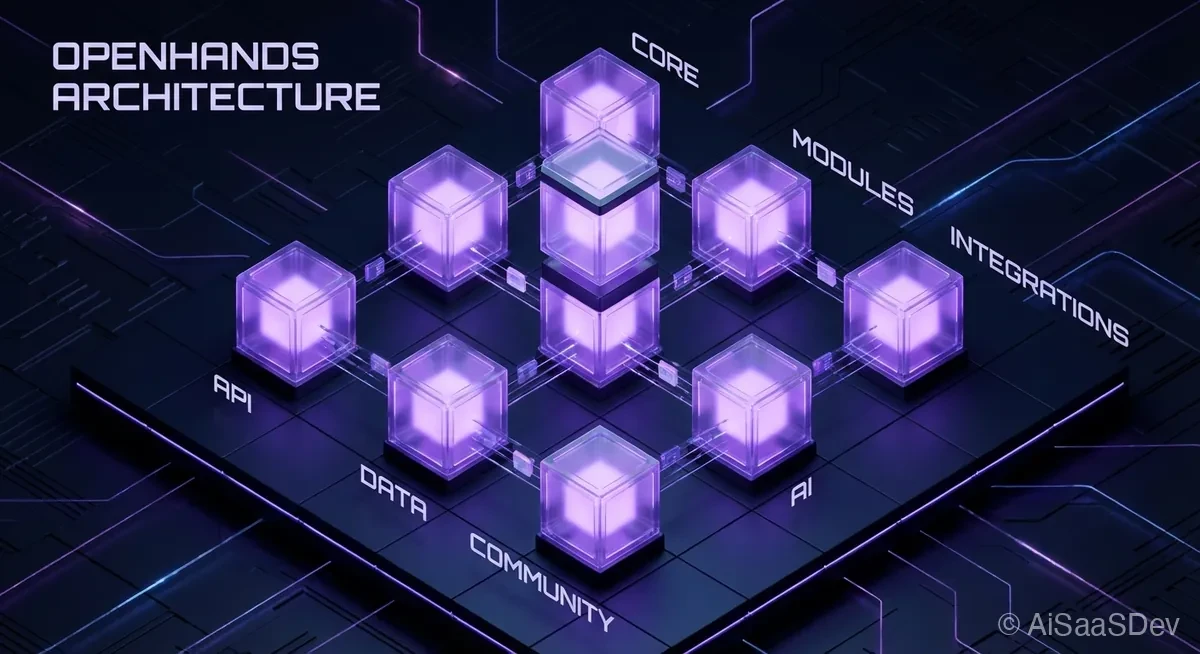
The system is architected around a decoupled Agent-Runtime model.
-
The Brain (Agent Core):
- Written in Python.
- Implements the
Observation -> Thought -> Actionloop. - LLM Agnostic: Connects to models like Claude 3.5 Sonnet (highly recommended for coding) or GPT-4o via standardized API layers.
- Event Stream: All actions (terminal commands, file edits) and observations (outputs, errors) are passed through an event bus, ensuring a linear, replayable history.
-
The Hands (Runtime & Sandbox):
- Docker-based: The
agent-serverimage provides the execution environment. - Jupyter Kernel Integration: Often uses Jupyter protocols to execute Python code interactively and capture rich output.
- File System Mounting: mounts your local workspace into the sandbox, allowing the agent to modify real files while keeping the execution environment isolated.
- Docker-based: The
-
The Interface:
- CLI: A headless mode for terminal-centric workflows (similar to Claude Code).
- GUI: A React-based single-page application (SPA) communicating via REST/WebSocket to the backend, visualizing the agent’s “thought process” and terminal output in real-time.
🚀 Quick Start
While the CLI is available, the most robust way to run OpenHands (ensuring the sandbox is correctly orchestrated) is via Docker.
Prerequisites: Docker must be running.
# 1. Set your Workspace (where the agent will write code)
export WORKSPACE_BASE=$(pwd)/workspace
mkdir -p $WORKSPACE_BASE

# 2. Run OpenHands (mounts docker socket for dind support)
docker run -it \
    --pull=always \
    -e SANDBOX_USER_ID=$(id -u) \
    -e WORKSPACE_MOUNT_PATH=$WORKSPACE_BASE \
    -v $WORKSPACE_BASE:/opt/workspace_base \
    -v /var/run/docker.sock:/var/run/docker.sock \
    -p 3000:3000 \
    --add-host host.docker.internal:host-gateway \
    --name openhands-app \
    ghcr.io/openhands/openhands:main

# 3. Access the GUI
# Open http://localhost:3000 in your browser.
# You will need to configure your LLM API Key (e.g., ANTHROPIC_API_KEY) in the settings UI.
SDK Usage (For Custom Agents)
If you are building on top of OpenHands, you use the Python SDK:
from openhands.core.schema import AgentState
from openhands.core.config import AppConfig
from openhands.controller import AgentController

# Initialize configuration
config = AppConfig()

# Define the agent (simplified representation)
controller = AgentController(
    agent="CodeActAgent",
    model="claude-3-5-sonnet-20240620",
    config=config
)

# Execute a task
task = "Refactor the authentication middleware in /src/auth.py"
await controller.start(task)
⚖️ The Verdict
Production Status: Early Enterprise / High-Maturity Experimental
OpenHands is arguably the most advanced open-source implementation of an AI Engineer today. The 77.6% SWE-Bench score is not a gimmick; it reflects a genuine ability to solve complex logic problems.
- For Individual Developers: Ready for daily use. The CLI and Local GUI are stable enough to offload scaffolding, refactoring, and test-writing tasks.
- For Enterprise: The existence of the
enterprise/directory (RBAC, Multi-user) signals a move toward commercial viability. However, allowing an agent autonomous write-access to shared repositories requires strict guardrails (sandboxing, PR reviews).
Recommendation: Use it to generate Pull Requests, not to push directly to main. The Docker sandbox architecture makes it safe to experiment with locally.
Recommended Reads

Is YuPi AI Guide Production Ready? Deep Dive & Setup Guide
Technical analysis of YuPi AI Guide. Architecture review, deployment guide, and production-readiness verdict. 2.7k stars.

Is Deepnote Production Ready? Deep Dive & Setup Guide
Technical analysis of Deepnote's open-source ecosystem. Architecture review of the reactivity engine, file format, and conversion tools. 2.5k stars.
Is Reasoning From Scratch Production Ready? Deep Dive & Setup Guide
Technical analysis of Reasoning From Scratch. Architecture review, deployment guide, and production-readiness verdict. 2.4k stars.