
Is Falcon-H1 Arabic the Future of DevTool? Deep Dive
Architecture review of Falcon-H1 Arabic. Pricing analysis, tech stack breakdown, and production viability verdict.
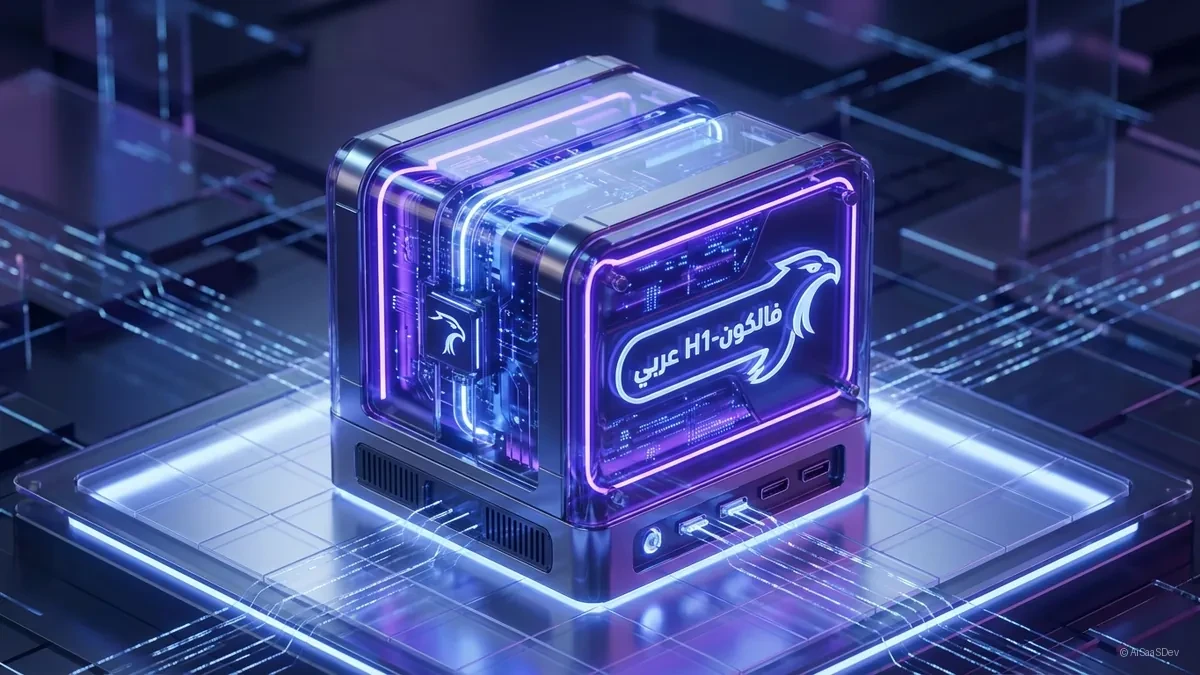
Architecture Review: Falcon-H1 Arabic
Falcon-H1 Arabic claims to be a Hybrid Mamba-Transformer LLM setting new standards for Arabic AI. Let’s look under the hood.
🛠️ The Tech Stack
Falcon-H1 Arabic represents a significant shift in Large Language Model (LLM) architecture, moving away from pure Transformer designs to a Hybrid Mamba-Transformer architecture.
- Core Architecture: The model interleaves State Space Model (SSM) blocks-specifically Mamba-with traditional Transformer attention layers. This hybrid approach aims to solve the “attention bottleneck,” offering the linear scalability of SSMs for long sequences while retaining the complex reasoning capabilities of attention mechanisms.
- Parameter Efficiency: Available in 3B, 7B, and 34B sizes. The 34B model reportedly outperforms significantly larger models like Llama-3.3 70B and Qwen2.5 72B on Arabic benchmarks (OALL), suggesting high parameter efficiency.
- Context Window: Supports a massive 256,000 token context window, enabling the processing of extensive documents (legal, medical) without the quadratic compute cost usually associated with Transformers.
- Training Data: Unlike models adapted from English, Falcon-H1 was trained “Arabic-first” on a mix of Modern Standard Arabic (MSA) and various dialects (Gulf, Levantine, Egyptian), addressing the chronic issue of dialectal performance in regional AI.
💰 Pricing Model
Model: Open Access / Free Infrastructure: Pay-as-you-go (Self-hosted)
- Open Weights: TII typically releases Falcon models under permissive licenses (often Apache 2.0 or TII Falcon License). While the specific license for H1 is freshly announced, the model weights are generally free to download for research and commercial application.
- Inference Costs: As this is a raw model release, the “price” is your compute cost.
- 3B Model: Can run on consumer hardware or edge devices (e.g., Apple Silicon, NVIDIA RTX 4090), making it effectively free for local dev use.
- 34B Model: Requires enterprise-grade GPUs (e.g., A100s/H100s) for efficient inference, pushing it into the “Paid” infrastructure tier for production deployment.
- Managed API: TII offers a playground, but enterprise usage would likely go through cloud partners (AWS Bedrock, Azure, etc.) where standard token-based pricing applies.
⚖️ Architect’s Verdict
Falcon-H1 Arabic is Deep Tech.
It is not a wrapper. It is a fundamental architectural innovation that successfully hybridizes two distinct neural network topologies.
For Developers:
- RAG Applications: The 256k context window combined with Mamba’s efficiency makes this the best-in-class choice for Arabic Retrieval-Augmented Generation (RAG) systems, allowing you to stuff entire legal codes or medical histories into the prompt with lower latency.
- Edge AI: The 3B model is a game-changer for mobile and IoT developers in the MENA region, enabling on-device Arabic intelligence that understands dialects-something previously impossible with English-centric quantized models.
- Sovereign AI: For government and enterprise sectors requiring data residency and strictly Arabic-native reasoning (not translation-based), this is currently the production standard.
Verdict: Production Ready. If you are building for the Arabic-speaking market, swap your Llama fine-tunes for Falcon-H1 immediately.
Recommended Reads

Is WebTerm the Future of DevTool? Deep Dive
Architecture review of WebTerm. Pricing analysis, tech stack breakdown, and production viability verdict.
Is Recent.dev the Future of DevTool? Deep Dive
Architecture review of Recent.dev. Pricing analysis, tech stack breakdown, and production viability verdict.
Is Ekamoira the Future of DevTool? Deep Dive
Architecture review of Ekamoira. Pricing analysis, tech stack breakdown, and production viability verdict.